How long does a debris windrow stay together before it disperses?
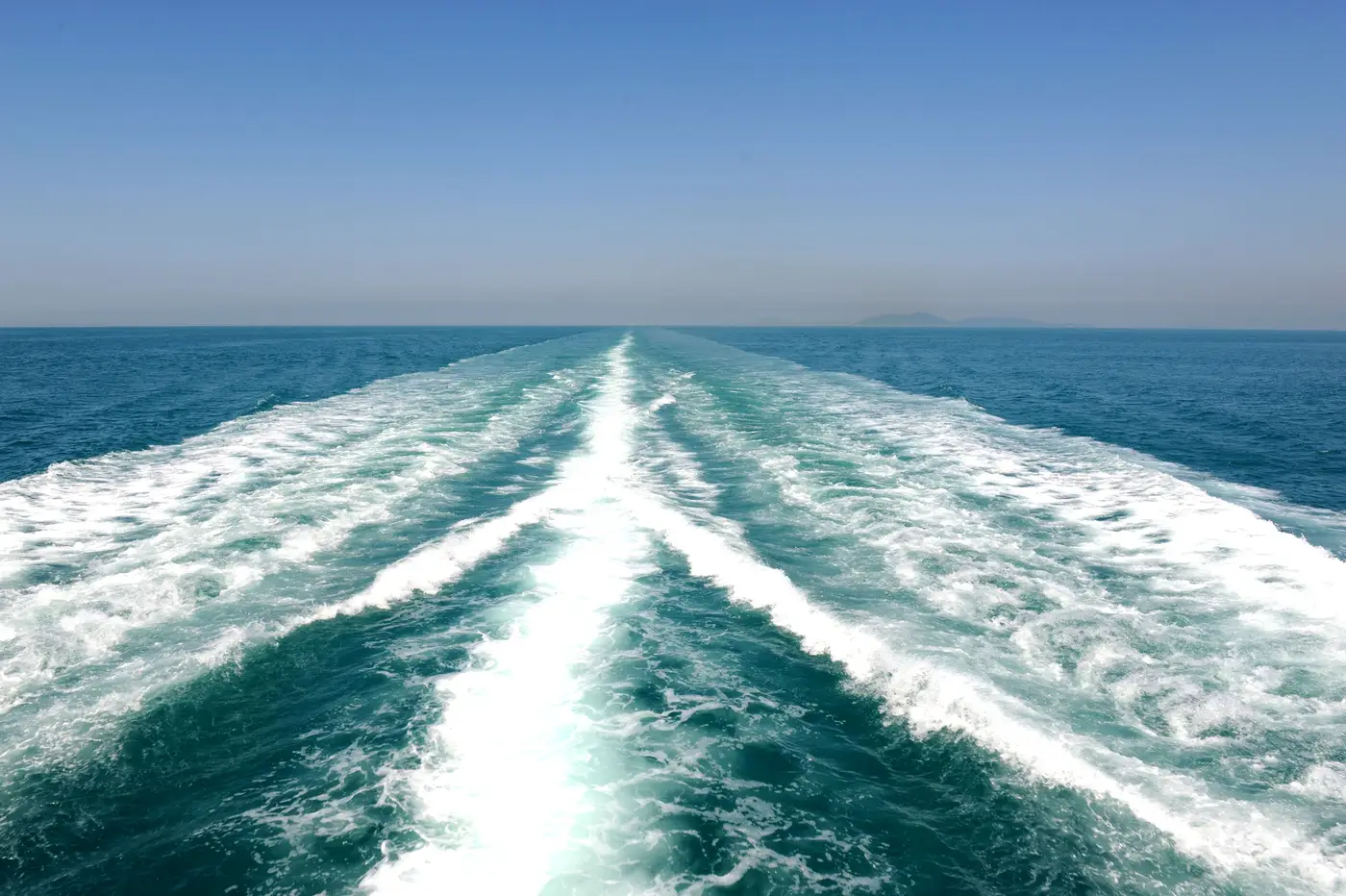
A windrow is the visible seam where wind and current push floating material into a line. It can form within an hour of a wind shift, and it can fall apart just as fast. The persistence window runs anywhere from under an hour to most of a day, set by whatever is doing the forcing: steady wind, a current edge, or a front.
What actually holds a windrow together
Windrows form from Langmuir circulation, the pairs of counter-rotating helical cells that a steady wind sets up just below the surface. Where two cells converge, water sinks and anything buoyant gets concentrated into a line running roughly parallel to the wind. That convergence is the glue. As long as wind speed and direction stay fairly constant, the line stays organized.
The moment that forcing changes, the glue lets go. A wind shift of 20-30 degrees can break a windrow into fragments within an hour or two. A passing squall does it faster. Flat calm does something different entirely: debris drifts off slowly under whatever residual current shear remains, since there's no wind left to drive the circulation that formed the line in the first place.
Typical persistence, by condition
Observations from drift studies and routine ship sightings point to a rough pattern rather than a fixed number:
- Steady wind, 10-15 knots, open water: windrows often hold 6-12 hours, sometimes reforming along the same axis overnight if the wind direction doesn't swing.
- Gusty or shifting wind: often less than three hours before the line smears into a diffuse patch.
- Near a front, eddy edge, or river plume boundary: persistence can run well past a day, because the current feature itself drives the convergence, and that feature holds on a slower clock than wind alone.
- Dead calm: the windrow mechanism barely starts. Debris just drifts with whatever current is present, and no organized line forms.
Sea state matters nearly as much as wind speed. Past roughly Beaufort 5, breaking waves and whitecaps mix the surface layer enough to tear a windrow apart no matter how steady the wind direction has been. Below that threshold, a line can survive a full tide cycle with nothing else to disturb it.
Why the timing matters before you commit a vessel
A windrow spotted at first light under a steady breeze might still be close to where it was at dawn by midmorning. The same line under a shifting sea breeze, which is common along coastlines in the afternoon, could be gone or split into three separate patches by the time a boat clears the harbor mouth.
That gap between a sighting and a location is the real problem. A coordinate logged six hours ago is a snapshot of a receding moment, and the wind record between that sighting and your launch tells you more than the sighting itself does.
Before dispatching, it helps to ask three things: how old is this sighting, what has the wind done since, and is there a converging feature nearby, a front, an eddy, a plume edge, that would hold the line together longer than wind alone. If that last answer is yes, the aggregation is still a reasonable bet hours later. If it's purely wind-driven and the wind has turned, treat the original fix as the start of a search pattern rather than a destination.
Catching that convergence early, before it breaks up or drifts out of reach, is the gap Plastic Detection works in: an event-driven read on where the spectral signature of a floating aggregation shows up on wide-swath imagery, so a research team or cleanup planner has a window to act while the aggregation is still holding together.
If scoping where to send a vessel next is part of your week, get on the early-access list for Plastic Detection.