What is a convergence zone in ocean surface currents?
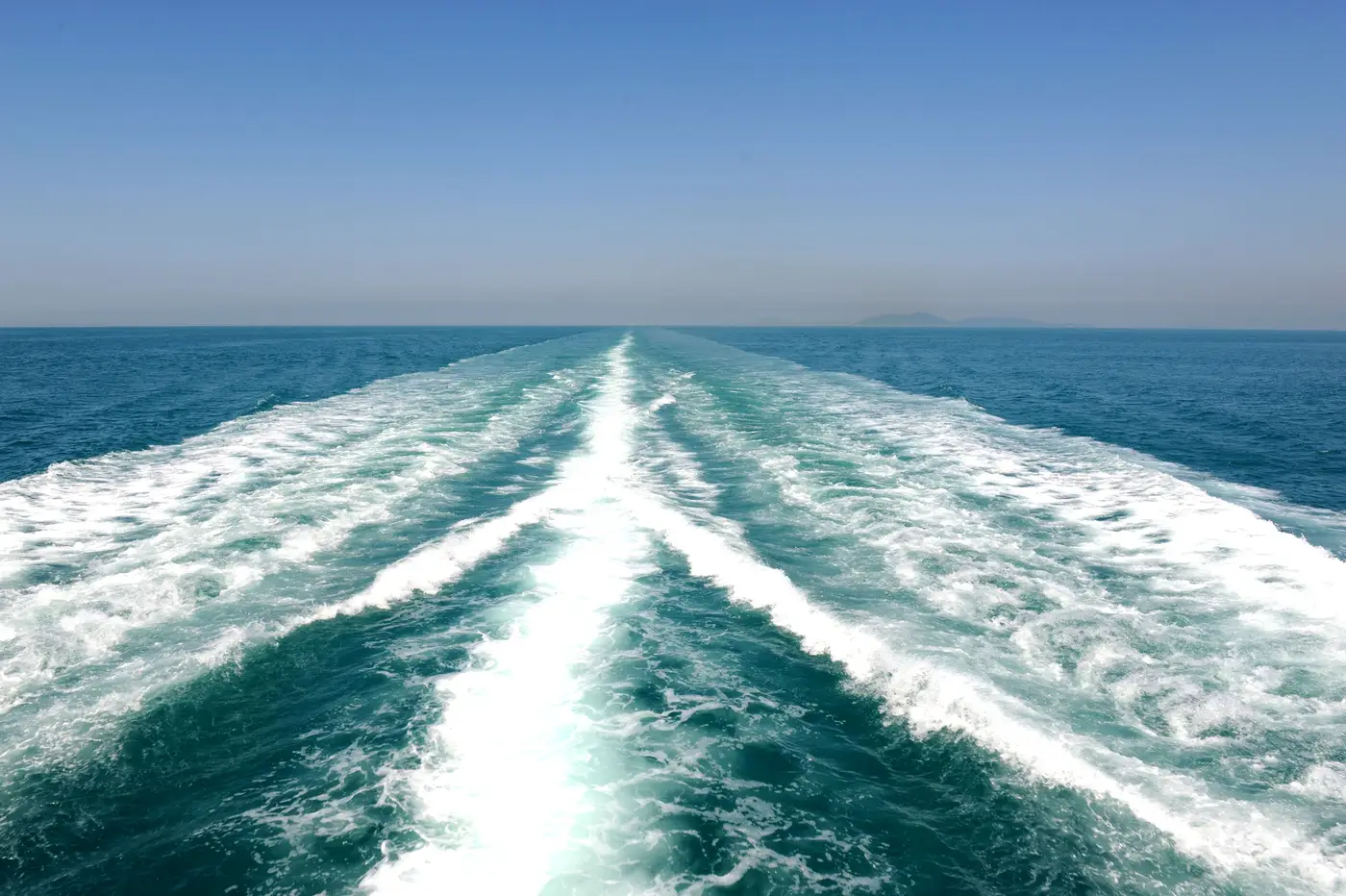
A convergence zone is a stretch of ocean where two surface currents, or a current and a wind-driven flow, run into each other. Water can't pile up indefinitely, so at the meeting line it does the only thing it can: it sinks. That downward motion is called downwelling, and it's the mechanism behind almost every floating debris line you'll ever chase on a cleanup transect.
Here's the part that matters for fieldwork. Water sinks at a convergence zone, but anything less dense than water doesn't follow it down. Plastic, foam, seaweed, tar balls, fish egg masses, pumice, all of it stays at the surface and gets pushed laterally into the narrowing seam between the two currents. Run that process for a few hours or a few days and you get a visible line of concentrated flotsam stretching across open water. Fishermen have called these slicks and rips for generations. Oceanographers call the resulting line a windrow.
Where convergence zones form
Convergence happens at a few predictable scales, and knowing which one you're dealing with changes how you plan a transit.
At the smallest scale, wind blowing steadily over the surface sets up counter-rotating rolls of water called Langmuir cells. Where two adjacent cells meet, you get narrow convergence lines a few meters to a few tens of meters apart, usually aligned roughly with the wind. These are the thin parallel streaks you see from a boat deck on a breezy day, often dotted with foam and small debris.
At a larger scale, ocean fronts mark the boundary between two water masses of different temperature, salinity, or density, say, a cold coastal current meeting a warmer offshore flow. Fronts are where biological productivity spikes (which is why they attract fishing fleets), and they're also where surface convergence tends to be strongest and most persistent. A front can hold its position for days or shift tens of kilometers overnight depending on wind and tidal forcing.
At the largest scale, the five subtropical gyres each have a center of convergence, which is why the "garbage patches" exist where they do. But between a Langmuir line and a gyre center sits a huge range of mesoscale eddies and frontal boundaries, and that middle range is usually where a cleanup operator or a research team needs to go.
Why debris accumulates at ocean fronts specifically
Fronts combine two things a Langmuir line doesn't have on its own: persistence and horizontal reach. A Langmuir cell might reorganize every time the wind shifts. A front tied to a bathymetric feature or a river plume boundary can sit in roughly the same place for a tidal cycle or longer, giving debris time to actually accumulate instead of just passing through a momentary convergence line.
Fronts also tend to stretch for kilometers, sometimes tens of kilometers, rather than the few meters of a Langmuir streak. That means more debris gets funneled into the same seam over a wider catch area. When a front is strong enough and has been in place long enough, the result isn't a faint line, it's a visible windrow, sometimes dense enough to show up as a distinct texture or color anomaly from above.
What this means before you commit a vessel
None of this tells you, in advance, where a front is sitting on a given day. Fronts move. They strengthen and weaken with wind forcing, tides, and freshwater input, and a windrow that was dense on Tuesday can disperse by Thursday if the convergence relaxes. That's the gap between knowing the mechanism and knowing where to point a boat this week.
Multispectral imagery picks up the same surface signal that makes windrows visible from a boat deck, concentrated floating material and the texture change at the front line, but from a wide satellite swath instead of a fixed vantage point. Plastic Detection turns that signal into an event-driven read on where debris is currently aggregating, so a research team or cleanup operator has somewhere to look before spending fuel and ship time on a transect.
If you're scoping a cleanup run or a research cruise around likely convergence zones, it's worth getting on the early-access list.