What is a windrow? How ocean debris lines actually form
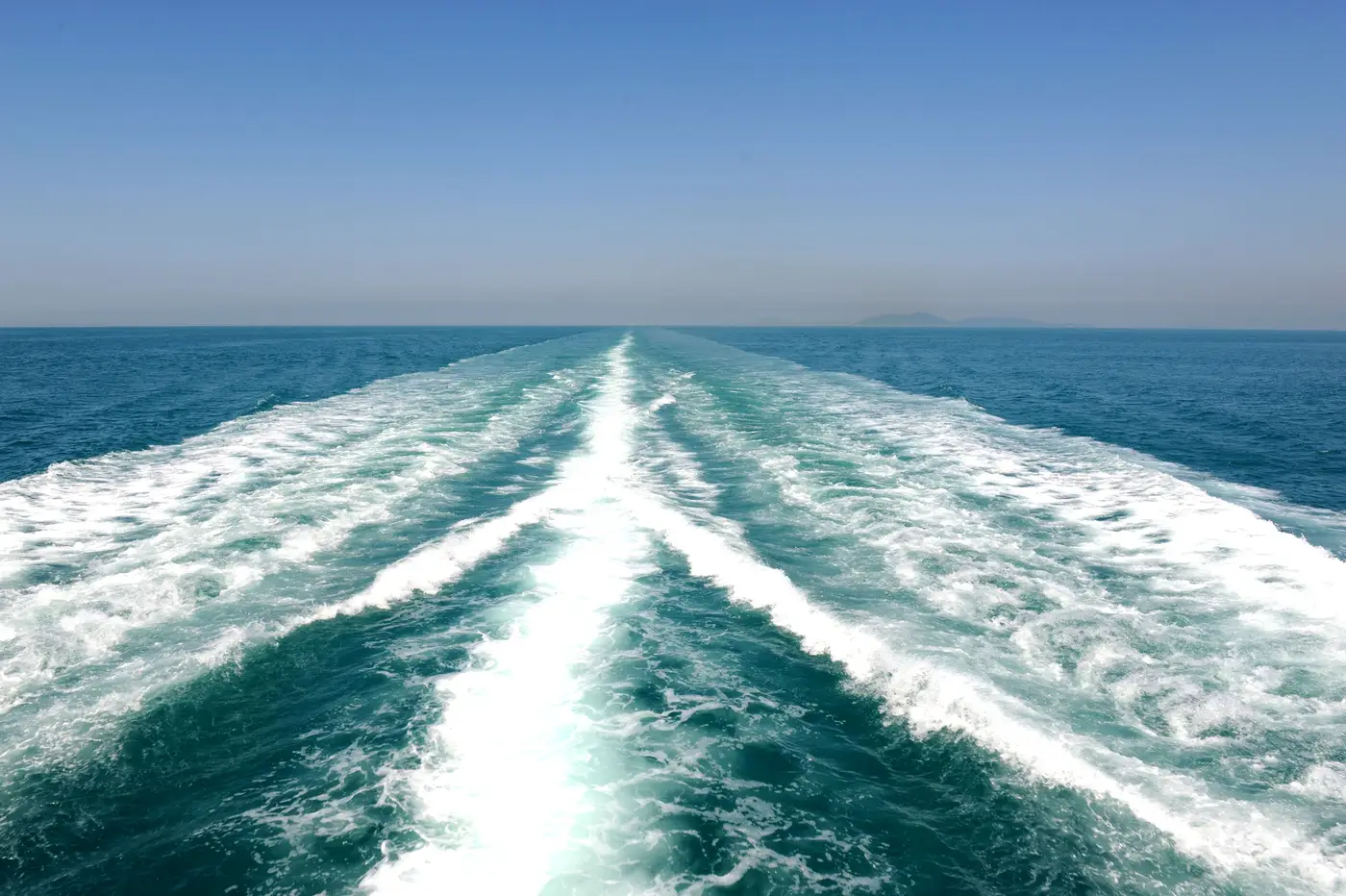
A windrow is a long, narrow band of floating material that collects on the sea surface where wind and water motion push debris together. Seaweed, foam, driftwood, and plastic all end up in the same streaks, lined up roughly parallel to the wind. If you've ever looked out from a research vessel and seen a thin ribbon of flotsam stretching toward the horizon, that's a windrow.
The term comes from agriculture, where cut hay is raked into rows to dry before baling. Oceanographers borrowed it because the pattern looks the same from above: material isn't spread evenly across the water, it's raked into lines.
How the lines actually form
Windrows are a product of Langmuir circulation, a set of counter-rotating helical cells that spin up in the upper water column when wind blows steadily across the surface, usually above about 3 meters per second. Where two adjacent cells converge, water sinks and surface material gets pushed together and held there. Where cells diverge, water rises and the surface stays relatively clear. The result is alternating bands of convergence and divergence, and anything buoyant, from Sargassum mats to microplastic fragments to a stray fishing float, gets funneled into the convergence lines.
The spacing between windrows usually runs anywhere from a few meters to tens of meters, and the lines themselves can stretch for hundreds of meters or more under sustained wind. Stronger, steadier wind tends to produce more organized, longer-lived rows. Gusty or shifting wind breaks them up fast.
That's the detail that trips people up: a windrow is not a fixed feature like a current boundary or an eddy. It's a transient convergence pattern tied directly to wind conditions at that moment. Kill the wind, or let it swing to a new direction, and the row disperses or reforms somewhere else within hours. A windrow a research team photographed at 9 a.m. may not exist by early afternoon.
Why this matters for debris aggregation and vessel planning
For anyone scoping a cleanup run, the windrow is the thing worth caring about, not the broad patch of ocean around it. Ambient plastic concentration across open water tends to be low and diffuse. A windrow is where that same plastic gets locally concentrated by an order of magnitude or more, simply because wind-driven convergence does the collecting for you. Sending a vessel to a windrow is efficient. Sending a vessel to the general area where a windrow was reported two days ago is often a wasted transit.
This is also where windrows get confused with larger debris accumulation zones like the oceanic garbage patches. Those patches are the product of basin-scale gyre circulation building up over years, and they're roughly stationary on the map. Windrows are the fine structure inside and around those zones, the local streaks where surface debris bunches up on a timescale of hours. A vessel working inside a known accumulation zone still has to find the windrows within it to make a collection run worthwhile.
Windrows are hard to see at the scale that matters, though. They're narrow, they shift with the wind, and a crew can't watch an entire search box from the deck. Satellite-based detection helps here because plastic, foam, and biological material in a convergence line produce a distinct spectral signature against open water once captured in multispectral imagery, even when the line itself is too thin to pick out in a plain visual image. That's the gap Plastic Detection is built to close: an event-driven read on where surface debris appears to be lining up, meant to help a team decide where a vessel is worth sending before it burns fuel and daylight checking a spot that's already dispersed.
If your team is trying to scope a search area before committing a vessel, it's worth seeing what that kind of early read can tell you.